
That’s changing. And the numbers behind the change are bigger than most people realize.
The Waste Problem Nobody Talks About
Bamboo is one of the most efficient plants on earth. It grows almost a metre a day in the right conditions, and a single clump can be harvested every year without replanting. But turning raw bamboo into a finished product, whether it’s a stick, a board, or a piece of furniture, leaves behind a lot of unused material. In stick-making alone, close to 40% of the bamboo gets discarded as waste.
Multiply that across an entire processing industry, and you get mountains of unused biomass. Left alone, it does real damage. Open burning releases smoke and particulate matter into the air. Left to rot in heaps, it degrades land instead of enriching it. For years, this was simply accepted as the cost of doing business with bamboo.
Nobody was asking the obvious question: what if the waste itself was the product?
India’s Strange Bamboo Paradox
Here’s a fact that surprises most people. India is the world’s second-largest producer of bamboo. And yet, for years, India has also been a net importer of bamboo and bamboo-based goods from countries like China.
That’s not a contradiction born from a shortage of raw material. It’s a gap in processing capacity, market coordination, and industrial use. Total wood consumption in India runs at roughly 70 million cubic metres a year, excluding fuelwood. Industry estimates suggest that even a modest 10% shift of that demand toward bamboo could generate around 7 million direct jobs, concentrated in exactly the rural areas that need them most.
That gap is exactly where the “waste into opportunity” story begins. The government’s National Bamboo Mission was built to close it, pushing plantation, processing, and market linkages together instead of leaving bamboo stuck as a handicraft-only material.
From Offcut to Income: What Actually Happens to the Waste
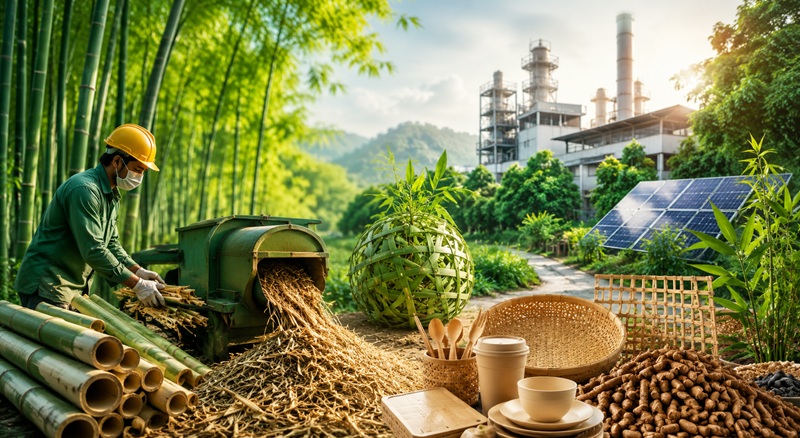
The shift from waste to resource isn’t one invention. It’s a handful of practical conversions, each solving a different part of the problem.
Bamboo charcoal and activated carbon. The splinters and knots that don’t fit into furniture or sticks get processed into charcoal, and further refined into activated carbon used for water filtration and industrial purification. Nothing fancy about the process, but it turns a fire hazard into a sellable product.
Bamboo pellets. Compressed under high pressure, waste bamboo becomes small, uniform pellets used as fuel in industrial boilers and thermal plants. They burn cleaner than coal and carry a high calorific value, which is why industries under pressure to cut emissions are increasingly buying them instead.
Packaging and building boards. Offcuts get shredded, bonded, and pressed into engineered boards, an alternative to plywood and plastic packaging that’s structurally close to cross-laminated timber, minus the environmental cost.
Everyday consumer goods. This is the layer most people actually touch, toothbrushes, straws, bottles, card holders, and hospitality amenities, made from bamboo that would otherwise have been discarded scrap.
None of these are experimental technologies. They’re running, scaling businesses right now, several of them started by first-generation entrepreneurs who looked at a waste pile and saw a supply chain instead.
The Money Behind the Shift
The scale here isn’t small change. A 2025 assessment of Odisha’s bamboo economy by the Council on Energy, Environment and Water estimated that cultivating bamboo on roughly 15,000 hectares of otherwise unused wasteland, about 3% of the state’s cultivable waste, could generate close to 29,000 jobs by 2030 in one state alone.
Break that down by category and the pattern holds. Bamboo-based packaging in Odisha alone was estimated at a market opportunity worth around USD 512 million by 2030, needing an investment of roughly USD 961 million to build the capacity, but generating close to 4,000 jobs in the process. Separately, India’s incense stick industry currently imports close to 150,000 metric tonnes of bamboo sticks a year. If a single state captured even 30% of that import share through local waste-to-stick production, it could create around 6,000 jobs across nearly 600 new production units.
Zoom out to the national picture and small-scale bamboo industries already generate more than USD 41 million in revenue in India, spread across products like agarbatti sticks, mats, blankets, fishing rods, furniture, and construction materials. That’s before accounting for the newer categories: pellets, activated carbon, and consumer goods, all of which are growing faster than the traditional handicraft segment.
Where This Story Touches Everyday Life
Most people will never visit a bamboo processing unit or read a market report. But they’ll hold the outcome of this shift in their hands anyway, a toothbrush, a bottle, a desk accessory, or a hotel amenity kit made from material that used to be scrap.
This is exactly the layer that Paivi works in, taking bamboo that would otherwise be waste and turning it into everyday products for homes and hospitality spaces. It’s a small piece of a much larger shift, but it’s the piece most people actually experience. If you want to see how this plays out across different formats, browsing the current collection is a good way to see the sheer variety this shift has already produced.
Why This Matters Beyond the Numbers
There’s an environmental argument here, obviously. Bamboo sequesters carbon fast, needs no replanting, and can grow on degraded land that’s unfit for most other crops. Converting its waste into usable products instead of burning it directly cuts emissions and land degradation at the source.
But the more interesting argument is economic. Rural bamboo economies don’t need new land, new water sources, or new imports to grow. They need better processing, better market access, and businesses willing to treat waste as a raw material rather than a disposal problem. That’s a rare kind of growth: one that doesn’t compete with food production, doesn’t strain water tables, and creates jobs in exactly the regions that usually get left out of India’s manufacturing story.
If you’re curious about the broader story behind sustainable materials like this, Paivi’s blog covers more of the shift happening across bamboo, packaging, and everyday sustainable living. And if you’d simply like to know more about the people behind this approach, Pavi’s own story is worth a read too.
The Bottom Line
Bamboo waste sat around for decades as a problem nobody wanted to solve. It burned, it rotted, it piled up outside processing units across the Northeast and beyond. What changed wasn’t the bamboo. It was the willingness of a few entrepreneurs, backed by policy pushes like the National Bamboo Mission, to look at that pile differently.
The businesses being built on that shift, pellets, charcoal, packaging, and consumer products, aren’t chasing a trend. They’re closing a gap that’s existed in India’s bamboo economy for years. And every bamboo product that replaces a plastic one, at home or in a hotel room, is a small, visible piece of that much bigger economic story.